Sunday, May 15, 2011

A Distant Election


The front page of the May 14, 2011 issue of anandabazar patrika that you see above announces the outcome of the recent elections in the Indian state of West Bengal. (Although I wasn't born there, I spent the first two decades of my life in Kolkata, the capital city of West Bengal, and continue to consider it my hometown.) In this election, the 34-year rule of the Communist Party of India (Marxist) -- and its considerably smaller coalition partners, including the Communist Party of India, from which the CPI(M) split in 1964 -- came to an ignominious end. Consequently, this election could, in the fullness of time, come to be regarded as a milestone in the history of West Bengal. (The election didn't go unnoticed in the U.S. press: see reports in The New York Times and in The Washington Post.)

Of the 294 seats in the West Bengal legislature, the CPI(M) won a mere 40 seats. By contrast, the Trinamul Congress -- the big winner -- won 184 seats.

In other words, dear reader, this was a blowout. This was like the hydrogen gas explosion that blew the roof off the Fukushima nuclear power plant. No, this was like the explosion that sank BP's Deepwater Horizon oil rig in the Gulf of Mexico. No no, what am I saying! This was like the Mount St. Helens eruption of 1980. No, silly me, that wasn't it either. This was like the Krakatoa eruption of 1883!

The communists came to power in West Bengal way back in 1977, when I was a teenager, and they have been in power ever since. I never understood how the CPI(M) kept winning election after election for more than three decades. Granted, they began well. They implemented important land reforms that distributed valuable land to destitute and landless agricultural workers. But that was an easy one-off achievement. If you have the electoral numbers to push your program through it doesn't take much creativity to grab land from Peter and give it to Paul. Land reform was the low-hanging fruit. After that fruit got plucked, things got tougher. Once you've done your Peter-to-Paul redistribution, for your next act you'll have to get a lot more creative. And if your creative idea for economic reform requires short-term pain for long-term gain, some clever corraling of political support will be needed. The communists turned out to be quite incapable of any of this. They slowly but surely ran the economy of West Bangal into the ground, while the rest of India raced ahead.

Towards the end they seemed to have seen the light. They began a desperate effort to lure private enterprise into West Bengal. But, barring some successes in the information technology sector, it was too little, too late.

Another factor behind the communists' long tenure in power in West Bengal was the general cluelessness of the opposition parties. These parties could not convince the electorate that they had good ideas or that the ideas that the communists had were bad ones. They did not have the muscle power to fight the communist cadres in the streets. They did not even have the guile to steal the communists clothes and convince the Bengali voter that they (the opposition parties) had the things that the Bengali people liked about the communists.

All that changed with the arrival of Ms. Mamata Banerjee -- that's her in the picture above -- and Trinamul Congress, the party that she almost single-handedly founded. Mamata is a highly imperfect political leader and it is completely unclear what she will do for West Bengal. But the people of West Bengal had grown sick and tired of the CPI(M) after 34 years of sub-par economic performance and constant political turmoil. And, I suspect that there is something about Mamata's gumption, her never-say-die spirit (that was so clearly in evidence in all her epic fights with the communists), and her emotional and excessively volatile demeanor that may have appealed to something deep in the psyche of the Bengali electorate. My late father, for example, was a big fan.

By the way, West Bengal -- along with two other Indian states, Kerala and Tripura -- can claim the very rare (and dubious?) distinction of having democratically elected communist governments. San Marino, an independent republic that is a really, really tiny landlocked enclave within Italy, is, as far as I know, the only example outside India. According to the Wikipedia entry on San Marino, "San Marino had the world's first democratically elected communist government, which held office between 1945 and 1957 and again between 2006 and 2008". However, another Wikipedia entry -- this one on E.M.S. Namboodiripad, a legendary Indian communist leader -- says this: "In 1957, EMS led the Communists to victory in the first election for the [Kerala] state government, making him the first communist leader anywhere to head a popularly elected government". Go figure!

Sunday, May 08, 2011

What the Sai Baba Phenomenon Says About India Today

The recent death, at the age of 85, of Sathyanarayana Raju, an Indian man whose numerous devotees considered him an incarnation of God, provides an opportunity to highlight the frightening degree of tolerance of corruption and dishonesty in Indian society. Please see below two TV documentaries on the deceased godman. (The documentaries are available on YouTube in ten-minute segments. I have never been able to figure out the logic behind or the purpose of YouTube's ten-minute limit.)

Seduced by Sai Baba (DR, Denmark, 2002)

The Secret Swami (BBC, 2004)

See also Miracle Man by K. Venkateshwarlu, Frontline, May 7, 2011.

A truly awful aspect of the entire episode is its clear demonstration of the utter shamelessness of the Indian establishment. Raju's funeral was attended by Dr. Manmohan Singh, the Prime Minster, and Ms. Sonia Gandhi, the President of the ruling Congress Party.

Good god!!

Wednesday, May 04, 2011

Let the Sun Shine In!


We need to listen to serious arguments, even when those making them are paid hacks. We also need to know that they are paid hacks.

Sunday, April 03, 2011

Trevor Swan, Unveiled


Trevor Swan (1918–1989) is an economist hero of mine. Even today's macroeconomists rely on the Solow-Swan model of 1956 to organize their thoughts on long-run economic growth. (I have never understood why Robert Solow alone was awarded the economics Nobel in 1987.) The Swan Diagram has been used by macroeconomists -- and still is, when exchange rates are not entirely flexible -- to deduce the combination of fiscal policy and exchange rate policy that is appropriate for given levels of the two big macroeconomic ailments, unemployment and inflation. Swan was also responsible for major innovations in the conduct of monetary policy as a member of the Australian Reserve Bank's monetary policy board.

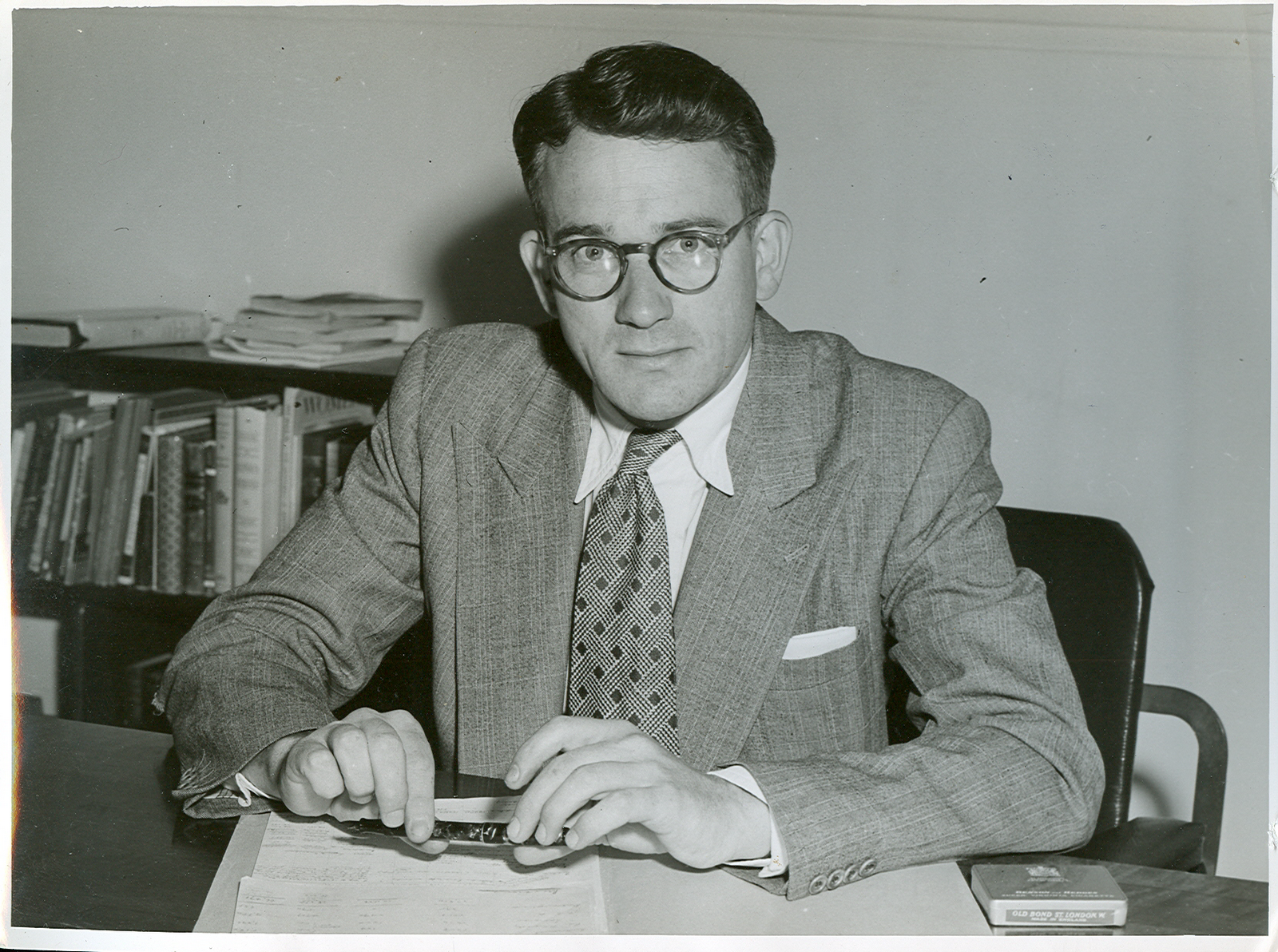
For quite a while, I have been searching on the Internet for images of Trevor Swan to post on my web site on the history of economic thought, but in vain. It was easy to find photographs of virtually every economist worth listing, but there was nothing on Trevor Swan.

Recently, however, my luck has turned, thanks to Prof. Barbara Spencer of the University of British Columbia, who is Swan's daughter (as well as a great economist and one of the pioneers of strategic trade theory). I had read her paper "Trevor Swan and the Neoclassical Growth Model," co-authored with Robert Dimand, History of Political Economy, 2009, and I knew that she was Swan's daughter. I had hoped to find a photograph of Swan without having to bother her. But, when Google fell through, I finally wrote to Prof. Spencer. I am now delighted to report that she has provided me with what I had been looking for.

The black-and-white photograph of Trevor Swan above was "taken in 1950 at his office after Trevor was appointed the first Chair in Economics at the Research School of Social Sciences [at the Australian National University]. He was only 32 years old." The two color portraits of Swan below were "taken around 1983 - 1985 by the Australian Reserve Bank. Trevor was a member of the bank board responsible for setting monetary policy from 1975-85."


My great thanks to Professor Spencer.

Tuesday, March 01, 2011

Mr. Mummy!

This is a video profile from today's New York Times of Prof. Bob Brier of the philosophy department of the C.W. Post Campus of Long Island University. The related blog post is here.

Thursday, February 17, 2011

Regulatory Relevance of the Value of a Human Life

This post is about As U.S. Agencies Put More Value on a Life, Businesses Fret by BINYAMIN APPELBAUM, a highly informative article in today's New York Times that will come in handy when I teach about public goods later this semester in my introductory microeconomics class.

There invariably are some commodities that businesses may not find profitable enough to produce and sell even though the public may really-really-really need them. This peculiarity arises when a commodity is -- jargon alert! -- non-excludable: that is, the commodity is such that those who don't want to pay for it cannot be excluded from consuming it anyway.

For example, clean air cannot be limited only to those who agree to pay for it, which is why businesses have no incentive to clean up the air we breathe. Protection from foreign enemies cannot be restricted to only those who pay for it, which is why -- Blackwater notwithstanding! -- national defense cannot be provided by private businesses. Broadcast radio and TV are also non-excludable. (Commercial broadcasters do exist, however, thanks to advertising.) The fruits of fundamental research -- think E = mc2, or Boyle's Law, or the Pythagorean Theorem, or existentialism -- while essential for human progress, are non-excludable too, which is why profit-seeking businesses are unlikely to invest in such research.

So, it is up to the government to pay for the things we need that businesses won't provide.

However, just because we would benefit from a commodity does not mean that the government should provide it -- costs must also be considered. Only if the benefits exceed the costs would it make sense for the government to step into the breach.

Unfortunately, this cost-benefit analysis can be a very tricky business.

For one thing, to figure the benefits of a public good -- technically, a public good is both non-excludable and non-rival, but I will not dwell on this issue here -- it may be necessary to have a dollar measure of the value of a human life!

Take tornado sirens, a popular example of a public good in econ textbooks. They save lives by emitting a loud sound that warns people about approaching tornadoes, giving them time to reach a safe bunker somewhere. But business can't make money by building such sirens because their services are not excludable: even those who refuse to pay will end up benefiting from the existence of the siren, and, knowing this, most people will refuse to pay.

Therefore, it is up to the government to provide a tornado siren. But such sirens cost money. What if the cost was a gazzillion trillion dollars and the benefit was 2 lives saved per year? Would a siren be worth the cost? Yes, if each human life was worth at least half a gazzillion trillion dolars; no, otherwise.

In other words, for rational public policy, a government would need to have a reliable dollar measure of the value of a human life.

Moreover, as Appelbaum's article makes clear, the rational regulation of industry is also heavily reliant on the government's estimate of the dollar value of a human life. Appelbaum also provides interesting examples of the application of the value-of-life concept to the regulation of auto safety, cigarette packaging, emissions from industrial boilers, etc.

U.S. businesses have expressed alarm that federal regulators have lately raised their value-of-life estimates -- in one case to $7.9 million per human -- because the higher the estimated dollar value of a human life, the stronger the justification for a regulation that restricts what businesses may do to cut costs at the expense of the safety of the general public.

The funny thing is that although federal regulators have recently raised their value-of-life estimates, they did so after a long period of torpor during which they refused to even adjust their estimates for inflation! Moreover, even the top-end estimates of the feds are less than the $8.7 million per human figure estimated by W. Kip Viscusi, the economist who initiated this whole approach to cost-benefit analysis. Nevertheless, the business lobby sees the government regulators as unrestrained and out of control! (By the way, why has Viscusi not won the economics Nobel yet? Are you listening, Bank of Sweden?)

It was during the Jimmy Carter presidency that the use of cost-benefit analysis was enshrined into U.S. law: every regulatory proposal would thenceforth have to come armed with a cost-benefit analysis. At that time the business community had welcomed this rationalization and de-politicization of the regulatory process. Now, however, the tide has turned and the politicians are more eager than ever to suck up to big business. This is why the U.S. Chamber of Commerce is now lobbying for the return of the use of political discretion and control of the regulatory process. As Appelbaum, brilliantly and mordantly writes, "The United States Chamber of Commerce is now campaigning for Congress to assert greater control over the rule-making process, reflecting a judgment that formulas may offer less reliable protection than politicians."

So true! In a plutocracy, the golden rule is that whoever has the gold makes the rules.

November 2026: Notable

Judge Richard A. Posner Has Died. His Influence in Law Was Beyond Compare.  By Adam Liptak, The New York Times, Nov. 13, 2026 Will Democrats...