I am a fan of the Kaiser Chiefs, a British indie rock band, and their 2004 debut single Oh My God. The song was also recorded in 2007 by Mark Ronson, a DJ much sought after by recording artists, and Lily Allen, a super-talented British singer. I like the original very much, but I prefer the Lily Allen version. The YouTube videos are given below; you decide which version you like better.
Friday, July 08, 2011

Wednesday, June 15, 2011
Combatting Female Feticide in India
This Economic and Political Weekly editorial on female feticide in India argues for (a) better enforcement of the anti-feticide law (duh!), (b) more consciousness-raising against the practice (ditto), and (c) stronger protection of women's economic rights to work and to inherit property. ("Impassioned Slogans, Half-hearted Actions," EPW, June 11, 2011, Vol. XLVI, No. 24.)
Why (c) would reduce female feticide is not explained in the editorial.
In certain sections of Indian Hindu society, a woman, upon marriage, comes to be regarded as a member of her husband's family. As a result, female children are regarded as a burden, an expensive investment that will one day go on to enrich her husband's family. This vicious logic, in some cases, fuels the selective abortion of female fetuses.
Now, given this chain of reasoning, why would the strengthening of the economic rights of women lead to lower levels of female feticide? If the parents of a female fetus are planning to kill her -- because, were she to live, she would soak up her parents' resources only to enrich the family she marries into -- why would they be dissuaded if the law strengthens her right to inherit her parents' property? (In fact the reverse may well be true: if women are shorn of their right to inherit their parents' property, parents of a female fetus may regard her as less of a bad investment and may well be persuaded to be a little merciful and let her live.)
Moreover, if the economic right of women to work is strengthened, her increased income would end up enriching not her initial family but her husband's, thereby providing no economic incentive against female feticide. You might think that a married woman with her own income would be likely to help her parents financially and that, consequently, stronger economic rights for women may reduce female feticide. But let's go back into the minds of the sort of people who kill female fetuses. They are conditioned to think of their married daughters as people of some other family. Therefore, it is unlikely that such people would expect any financial help from their married daughters, irrespective of whether they earned a paycheck or not.
Needless to say, the strengthening of the economic rights of Indian women is valuable in itself. But why the EPW thinks this would reduce the slaughter of female fetuses is unclear to me.
I have been thinking, for a while now, that India needs to try providing a sizable subsidy for every newborn girl. However, I was somewhat discouraged about the likely effectiveness of my subsidy idea when the Lancet study (mentioned in the EPW editorial) revealed that "selective abortion of the female foetus is the highest in the most educated and in the richest 20% of the households." After all, such families are unlikely to be persuaded to be merciful by a mere subsidy, I thought.
But another finding of the Lancet study gives me some hope that a workable subsidy may yet be implementable. "[W]hen the first child was a male, there was no fall in the sex ratio of the second child. But when the first born was a female, the sex ratio of the second births declined." In other words, the danger of the murder of a female fetus is really serious only when the mother has already had a daughter and is now hoping for a son. So, instead of giving a subsidy for every newborn girl, it may be a good idea to start with a less ambitious subsidy for parents only if their second child is also their second daughter. (The previous sentence has been slightly revised.) And as this would be a limited subsidy, its size could be made very large -- large enough perhaps to tempt even the rich to show some mercy.
Sunday, May 15, 2011
A Distant Election

The front page of the May 14, 2011 issue of anandabazar patrika that you see above announces the outcome of the recent elections in the Indian state of West Bengal. (Although I wasn't born there, I spent the first two decades of my life in Kolkata, the capital city of West Bengal, and continue to consider it my hometown.) In this election, the 34-year rule of the Communist Party of India (Marxist) -- and its considerably smaller coalition partners, including the Communist Party of India, from which the CPI(M) split in 1964 -- came to an ignominious end. Consequently, this election could, in the fullness of time, come to be regarded as a milestone in the history of West Bengal. (The election didn't go unnoticed in the U.S. press: see reports in The New York Times and in The Washington Post.)
Of the 294 seats in the West Bengal legislature, the CPI(M) won a mere 40 seats. By contrast, the Trinamul Congress -- the big winner -- won 184 seats.
In other words, dear reader, this was a blowout. This was like the hydrogen gas explosion that blew the roof off the Fukushima nuclear power plant. No, this was like the explosion that sank BP's Deepwater Horizon oil rig in the Gulf of Mexico. No no, what am I saying! This was like the Mount St. Helens eruption of 1980. No, silly me, that wasn't it either. This was like the Krakatoa eruption of 1883!
The communists came to power in West Bengal way back in 1977, when I was a teenager, and they have been in power ever since. I never understood how the CPI(M) kept winning election after election for more than three decades. Granted, they began well. They implemented important land reforms that distributed valuable land to destitute and landless agricultural workers. But that was an easy one-off achievement. If you have the electoral numbers to push your program through it doesn't take much creativity to grab land from Peter and give it to Paul. Land reform was the low-hanging fruit. After that fruit got plucked, things got tougher. Once you've done your Peter-to-Paul redistribution, for your next act you'll have to get a lot more creative. And if your creative idea for economic reform requires short-term pain for long-term gain, some clever corraling of political support will be needed. The communists turned out to be quite incapable of any of this. They slowly but surely ran the economy of West Bangal into the ground, while the rest of India raced ahead.
Towards the end they seemed to have seen the light. They began a desperate effort to lure private enterprise into West Bengal. But, barring some successes in the information technology sector, it was too little, too late.
Another factor behind the communists' long tenure in power in West Bengal was the general cluelessness of the opposition parties. These parties could not convince the electorate that they had good ideas or that the ideas that the communists had were bad ones. They did not have the muscle power to fight the communist cadres in the streets. They did not even have the guile to steal the communists clothes and convince the Bengali voter that they (the opposition parties) had the things that the Bengali people liked about the communists.
All that changed with the arrival of Ms. Mamata Banerjee -- that's her in the picture above -- and Trinamul Congress, the party that she almost single-handedly founded. Mamata is a highly imperfect political leader and it is completely unclear what she will do for West Bengal. But the people of West Bengal had grown sick and tired of the CPI(M) after 34 years of sub-par economic performance and constant political turmoil. And, I suspect that there is something about Mamata's gumption, her never-say-die spirit (that was so clearly in evidence in all her epic fights with the communists), and her emotional and excessively volatile demeanor that may have appealed to something deep in the psyche of the Bengali electorate. My late father, for example, was a big fan.
By the way, West Bengal -- along with two other Indian states, Kerala and Tripura -- can claim the very rare (and dubious?) distinction of having democratically elected communist governments. San Marino, an independent republic that is a really, really tiny landlocked enclave within Italy, is, as far as I know, the only example outside India. According to the Wikipedia entry on San Marino, "San Marino had the world's first democratically elected communist government, which held office between 1945 and 1957 and again between 2006 and 2008". However, another Wikipedia entry -- this one on E.M.S. Namboodiripad, a legendary Indian communist leader -- says this: "In 1957, EMS led the Communists to victory in the first election for the [Kerala] state government, making him the first communist leader anywhere to head a popularly elected government". Go figure!
Sunday, May 08, 2011
What the Sai Baba Phenomenon Says About India Today
The recent death, at the age of 85, of Sathyanarayana Raju, an Indian man whose numerous devotees considered him an incarnation of God, provides an opportunity to highlight the frightening degree of tolerance of corruption and dishonesty in Indian society. Please see below two TV documentaries on the deceased godman. (The documentaries are available on YouTube in ten-minute segments. I have never been able to figure out the logic behind or the purpose of YouTube's ten-minute limit.)

Seduced by Sai Baba (DR, Denmark, 2002)
- Part 1 http://youtu.be/nsPwhkqboSI (introduction)
- Part 2 http://youtu.be/44uX8JcpXQ4 (holy ash and jewelry scam)
- Part 3 http://youtu.be/XF_LDKgODZE (amrit, alchemy, sexual abuse)
- Part 4 http://youtu.be/FFX47jL8Osk (sexual abuse of underage boys)
- Part 5 http://youtu.be/YoPZc0WgtK4 (sexual abuse of underage boys)
- Part 6 http://youtu.be/mvEJi2YNsvU (sexual abuse of underage boys and a possible link to the mysterious police killiings of four men in Sai Baba's apartment in 1993)
The Secret Swami (BBC, 2004)
- Part 1 http://youtu.be/_BVEJDPrGpM (introduction)
- Part 2 http://youtu.be/i-Ajawd59RM (Western devotees)
- Part 3 http://youtu.be/Ag93TX6DI0w (The Rahm Family of Arkansas and Alaya Rahm, immaculate materialization scams, Mark Roche)
- Part 4 http://youtu.be/CROnyK2fzcs (sex abuse of Alaya Rahm, regurgitation scam)
- Part 5 http://youtu.be/1PHsxBEYI9g (Murli Manohar Joshi)
- Part 6 http://youtu.be/6Q4M2raOwPI (The police killing of four "boys" armed with knives in Sai Baba's apartment)
- Part 7 http://youtu.be/mGZ3Bdjvg3I (legacy of corruption)
See also Miracle Man by K. Venkateshwarlu, Frontline, May 7, 2011.
A truly awful aspect of the entire episode is its clear demonstration of the utter shamelessness of the Indian establishment. Raju's funeral was attended by Dr. Manmohan Singh, the Prime Minster, and Ms. Sonia Gandhi, the President of the ruling Congress Party.
Good god!!
Thursday, May 05, 2011

Wednesday, May 04, 2011
Let the Sun Shine In!
We need to listen to serious arguments, even when those making them are paid hacks. We also need to know that they are paid hacks.
Sunday, April 03, 2011
Trevor Swan, Unveiled
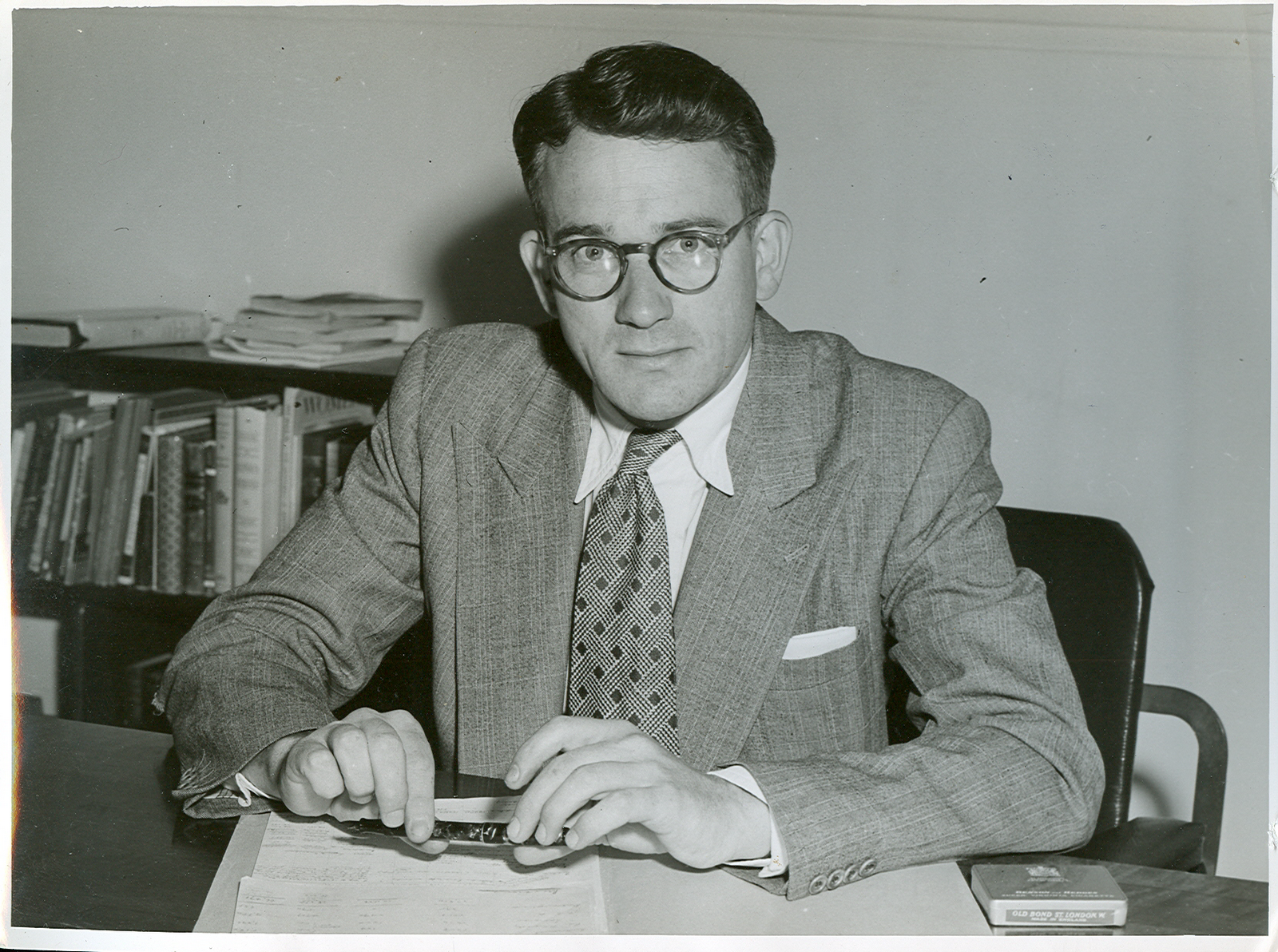
Trevor Swan (1918–1989) is an economist hero of mine. Even today's macroeconomists rely on the Solow-Swan model of 1956 to organize their thoughts on long-run economic growth. (I have never understood why Robert Solow alone was awarded the economics Nobel in 1987.) The Swan Diagram has been used by macroeconomists -- and still is, when exchange rates are not entirely flexible -- to deduce the combination of fiscal policy and exchange rate policy that is appropriate for given levels of the two big macroeconomic ailments, unemployment and inflation. Swan was also responsible for major innovations in the conduct of monetary policy as a member of the Australian Reserve Bank's monetary policy board.
For quite a while, I have been searching on the Internet for images of Trevor Swan to post on my web site on the history of economic thought, but in vain. It was easy to find photographs of virtually every economist worth listing, but there was nothing on Trevor Swan.
Recently, however, my luck has turned, thanks to Prof. Barbara Spencer of the University of British Columbia, who is Swan's daughter (as well as a great economist and one of the pioneers of strategic trade theory). I had read her paper "Trevor Swan and the Neoclassical Growth Model," co-authored with Robert Dimand, History of Political Economy, 2009, and I knew that she was Swan's daughter. I had hoped to find a photograph of Swan without having to bother her. But, when Google fell through, I finally wrote to Prof. Spencer. I am now delighted to report that she has provided me with what I had been looking for.
The black-and-white photograph of Trevor Swan above was "taken in 1950 at his office after Trevor was appointed the first Chair in Economics at the Research School of Social Sciences [at the Australian National University]. He was only 32 years old." The two color portraits of Swan below were "taken around 1983 - 1985 by the Australian Reserve Bank. Trevor was a member of the bank board responsible for setting monetary policy from 1975-85."


My great thanks to Professor Spencer.
Subscribe to:
Posts (Atom)
-
Although I was born in Philadelphia, I spent the first twenty-two years of my life growing up in Calcutta (now Kolkata ), the capital city o...
-
Just read a fascinating article on the dysfunctional nature of India's medical education system: India’s private medical colleges and c...
-
 Trevor Swan (1918–1989) is an economist hero of mine. Even today's macroeconomists rely on the Solow-Swan model of 1956 to organize t...